
I would like to express my gratitude to Kaggle and University College London for hosting this competition. I learned a great deal, and it was truly an exciting experience.
\n ():\n df = pd.DataFrame(data)\n\n mean = df.rolling(window = window, center = , min_periods = ).mean()\n std = df.rolling(window = window, center = , min_periods = ).std()\n\n mask = (df - mean).() > (threshold * std)\n\n df[mask] = mean[mask]\n data = df.to_numpy()\n data\n

Pool(processes = os.cpu_count()) pool:\n res = least_squares(\n fun = fun,\n x0 = x0,\n bounds = bounds,\n method = ,\n jac_sparsity = jac_sparsity,\n args = (time, star_info, param_info, targets),\n workers = pool.,\n verbose = plot ,\n )\n

inputs = np.concatenate([\n T,\n T[:, :] - T[:, :],\n T[:, :] - T[:, :],\n\n rp[:, :-].mean(, keepdims = ),\n c1[:, :-].mean(, keepdims = ),\n c2[:, :-].mean(, keepdims = ),\n c3[:, :-].mean(, keepdims = ),\n c4[:, :-].mean(, keepdims = ),\n\n rp[:, :-].std(, keepdims = ),\n c1[:, :-].std(, keepdims = ),\n c2[:, :-].std(, keepdims = ),\n c3[:, :-].std(, keepdims = ),\n c4[:, :-].std(, keepdims = ),\n\n cost,\n nfev,\n\n star_info.values,\n], axis = )\nhttps://github.com/siwooyong/NeurIPS-Ariel-Data-Challenge-2025
", "messages": [ { "id": 3294984, "postDate": "2025-09-27T09:50:21.577Z", "content": "I would like to express my gratitude to Kaggle and University College London for hosting this competition. I learned a great deal, and it was truly an exciting experience.
\n ():\n df = pd.DataFrame(data)\n\n mean = df.rolling(window = window, center = , min_periods = ).mean()\n std = df.rolling(window = window, center = , min_periods = ).std()\n\n mask = (df - mean).() > (threshold * std)\n\n df[mask] = mean[mask]\n data = df.to_numpy()\n data\n
Pool(processes = os.cpu_count()) pool:\n res = least_squares(\n fun = fun,\n x0 = x0,\n bounds = bounds,\n method = ,\n jac_sparsity = jac_sparsity,\n args = (time, star_info, param_info, targets),\n workers = pool.,\n verbose = plot ,\n )\n
inputs = np.concatenate([\n T,\n T[:, :] - T[:, :],\n T[:, :] - T[:, :],\n\n rp[:, :-].mean(, keepdims = ),\n c1[:, :-].mean(, keepdims = ),\n c2[:, :-].mean(, keepdims = ),\n c3[:, :-].mean(, keepdims = ),\n c4[:, :-].mean(, keepdims = ),\n\n rp[:, :-].std(, keepdims = ),\n c1[:, :-].std(, keepdims = ),\n c2[:, :-].std(, keepdims = ),\n c3[:, :-].std(, keepdims = ),\n c4[:, :-].std(, keepdims = ),\n\n cost,\n nfev,\n\n star_info.values,\n], axis = )\nhttps://github.com/siwooyong/NeurIPS-Ariel-Data-Challenge-2025
", "rawMarkdown": "I would like to express my gratitude to Kaggle and University College London for hosting this competition. I learned a great deal, and it was truly an exciting experience.\n\n\n\n# Summary\n1. Preprocess : noise reduction\n2. Stage 1 : transit time prediction & filtering bad samples\n3. Stage2 : physics-based transit modeling & 2d global fitting\n4. Postprocess : ml-based sigma prediction & simple refinements\n\n\n\n# Preprocess : noise reduction\n- Applied all standard preprocessing functions except for the mask_hot_dead function.\n- For time binning, 30 is used for airs_ch0 channels, and 30 × 12 is used for fgs1 channel.\n- The spatial dimension is cropped to the range 8 ~ 24.\n- The remove_outlier function modifies outliers in the data using the local mean.\n- The effect of the remove_outlier function can be confirmed in the following figure.\n\n```python\ndef remove_outlier(data, window = 100, threshold = 5.0):\n df = pd.DataFrame(data)\n \n mean = df.rolling(window = window, center = True, min_periods = 1).mean()\n std = df.rolling(window = window, center = True, min_periods = 1).std()\n \n mask = (df - mean).abs() > (threshold * std)\n \n df[mask] = mean[mask]\n data = df.to_numpy()\n return data\n```\n\n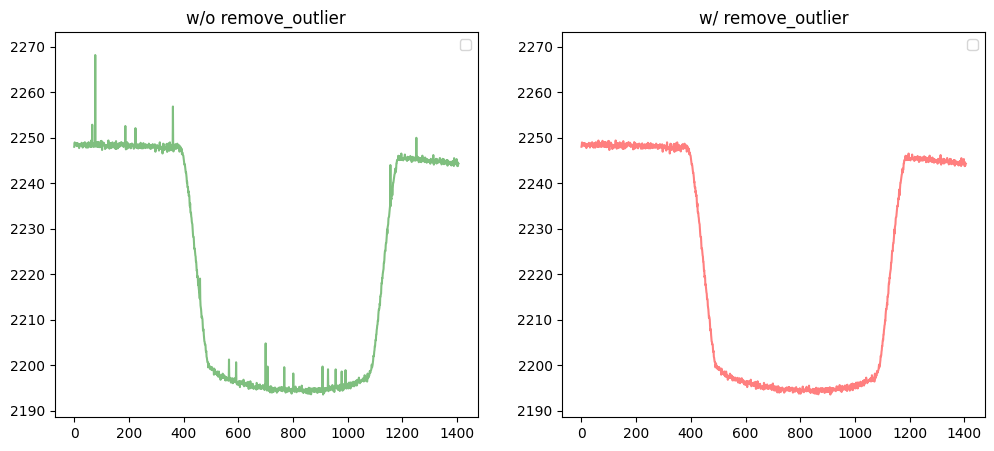\n\n\n\n# Stage1 : transit time prediction & filtering bad samples\n- The input is obtained by averaging all channels and then normalizing.\n- Transit and system are modeled with simple polynomials to predict T1, T2, T3, T4.\n- Additionally, Success or not is predicted to prevent negative scores from bad samples.\n- If success == False, wl and sigma are set to the train dataset’s mean and std.\n- Criteria for success = False:\n 1. Fitting error > 1e-3 \n 2. T1 < 0.01 or T4 > 0.99\n- The Stage 1 fitting results is visualized in the following figure.\n\n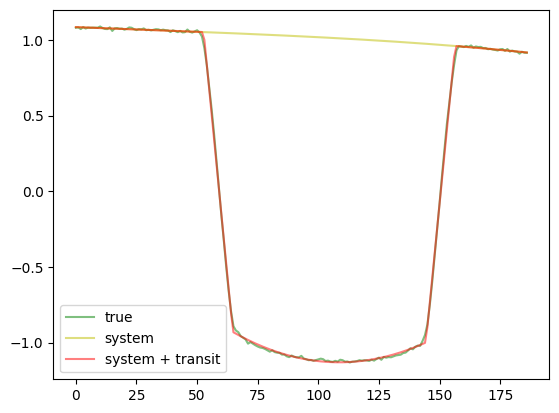\n\n\n\n# Stage2 : physics-based transit modeling & 2d global fitting\n- Implemented a custom nonlinear limb darkening pipeline (c1, c2, c3, c4), inspired by the batman library.\n- To avoid unrealistic cases (where c1 + c2 + c3 + c4 > 1), each coefficient is capped at 0.25.\n- Used least_squares for global fitting across all channels with parameters: rp, c1, c2, c3, c4, P, sma, i, t0.\n- Applied tanh to c1–c4 (range -1 to 1) for better convergence stability and easier max constraints.\n- Constructed jac_sparsity to predefine parameter correlations and speed up convergence.\n- Adopted the previous competition’s 1st-place approach: system = 1 + f(time) × g(wavelength).\n- To mitigate degeneracy between limb darkening effect and system effect, a 2-step fitting is used:\n 1. Step 1 : f & g modeled as 3rd-order polynomials.\n 2. Step 2 : f & g modeled as 4th-order polynomials.\n- This allows limb darkening coefficients to converge first, reducing errors from degeneracy.\n- For faster computation, wavelength binning of 4 is applied.\n- Since channels beyond 200 in airs_ch0 have severe noise, a window size of 50 is used.\n- The target of the Stage 2 fitting is visualized in the following figure.\n\n```python\nwith Pool(processes = os.cpu_count()) as pool:\n res = least_squares(\n fun = fun,\n x0 = x0,\n bounds = bounds,\n method = 'trf',\n jac_sparsity = jac_sparsity,\n args = (time, star_info, param_info, targets),\n workers = pool.map,\n verbose = 2 if plot else 0,\n )\n```\n\n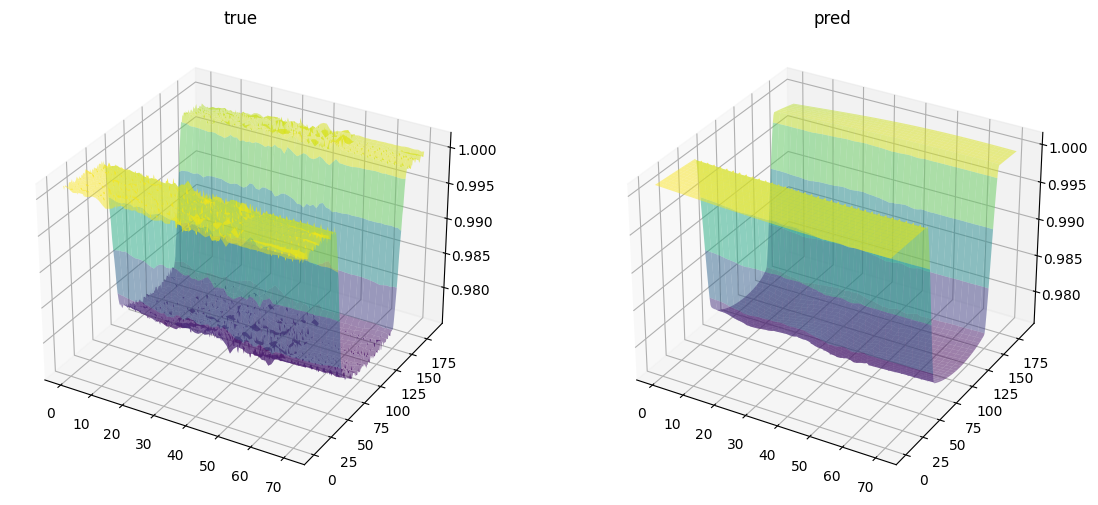\n\n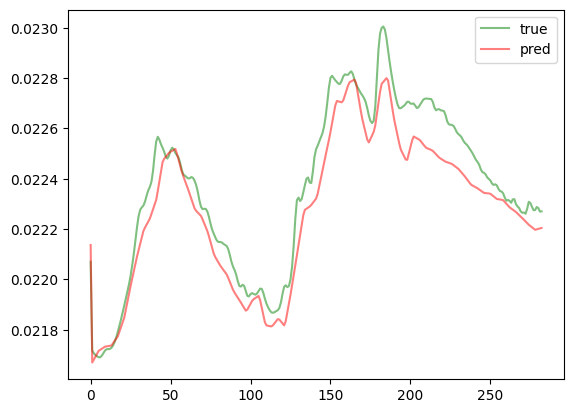\n\n\n\n# Postprocess : ml-based sigma prediction & simple refinements\n- inputs = parameters obtained from stage 1 and stage 2 for the training data.\n- targets = optimal sigma per sample, computed over np.linspace(5e-5, 2e-3, 500).\n- Applied a 4-fold ensemble of GradientBoostingRegressor for inference.\n- For the fgs1 channel, results are simply scaled by ×2 from airs_ch0 channels.\n- Additional refinements -> wavelength scaling, gaussian_filter1d, and PCA.\n\n```python\ninputs = np.concatenate([\n T,\n T[:, 3:4] - T[:, 0:1],\n T[:, 2:3] - T[:, 1:2],\n\n rp[:, :-1].mean(1, keepdims = True),\n c1[:, :-1].mean(1, keepdims = True),\n c2[:, :-1].mean(1, keepdims = True),\n c3[:, :-1].mean(1, keepdims = True),\n c4[:, :-1].mean(1, keepdims = True),\n\n rp[:, :-1].std(1, keepdims = True),\n c1[:, :-1].std(1, keepdims = True),\n c2[:, :-1].std(1, keepdims = True),\n c3[:, :-1].std(1, keepdims = True),\n c4[:, :-1].std(1, keepdims = True),\n\n cost,\n nfev,\n\n star_info.values,\n], axis = 1)\n```\n\n\n\n# Code\nhttps://github.com/siwooyong/NeurIPS-Ariel-Data-Challenge-2025", "votes": 14 } ], "comments": [], "raw_markdown_by_id": { "3294984": "I would like to express my gratitude to Kaggle and University College London for hosting this competition. I learned a great deal, and it was truly an exciting experience.\n\n\n\n# Summary\n1. Preprocess : noise reduction\n2. Stage 1 : transit time prediction & filtering bad samples\n3. Stage2 : physics-based transit modeling & 2d global fitting\n4. Postprocess : ml-based sigma prediction & simple refinements\n\n\n\n# Preprocess : noise reduction\n- Applied all standard preprocessing functions except for the mask_hot_dead function.\n- For time binning, 30 is used for airs_ch0 channels, and 30 × 12 is used for fgs1 channel.\n- The spatial dimension is cropped to the range 8 ~ 24.\n- The remove_outlier function modifies outliers in the data using the local mean.\n- The effect of the remove_outlier function can be confirmed in the following figure.\n\n```python\ndef remove_outlier(data, window = 100, threshold = 5.0):\n df = pd.DataFrame(data)\n \n mean = df.rolling(window = window, center = True, min_periods = 1).mean()\n std = df.rolling(window = window, center = True, min_periods = 1).std()\n \n mask = (df - mean).abs() > (threshold * std)\n \n df[mask] = mean[mask]\n data = df.to_numpy()\n return data\n```\n\n\n\n\n\n# Stage1 : transit time prediction & filtering bad samples\n- The input is obtained by averaging all channels and then normalizing.\n- Transit and system are modeled with simple polynomials to predict T1, T2, T3, T4.\n- Additionally, Success or not is predicted to prevent negative scores from bad samples.\n- If success == False, wl and sigma are set to the train dataset’s mean and std.\n- Criteria for success = False:\n 1. Fitting error > 1e-3 \n 2. T1 < 0.01 or T4 > 0.99\n- The Stage 1 fitting results is visualized in the following figure.\n\n\n\n\n\n# Stage2 : physics-based transit modeling & 2d global fitting\n- Implemented a custom nonlinear limb darkening pipeline (c1, c2, c3, c4), inspired by the batman library.\n- To avoid unrealistic cases (where c1 + c2 + c3 + c4 > 1), each coefficient is capped at 0.25.\n- Used least_squares for global fitting across all channels with parameters: rp, c1, c2, c3, c4, P, sma, i, t0.\n- Applied tanh to c1–c4 (range -1 to 1) for better convergence stability and easier max constraints.\n- Constructed jac_sparsity to predefine parameter correlations and speed up convergence.\n- Adopted the previous competition’s 1st-place approach: system = 1 + f(time) × g(wavelength).\n- To mitigate degeneracy between limb darkening effect and system effect, a 2-step fitting is used:\n 1. Step 1 : f & g modeled as 3rd-order polynomials.\n 2. Step 2 : f & g modeled as 4th-order polynomials.\n- This allows limb darkening coefficients to converge first, reducing errors from degeneracy.\n- For faster computation, wavelength binning of 4 is applied.\n- Since channels beyond 200 in airs_ch0 have severe noise, a window size of 50 is used.\n- The target of the Stage 2 fitting is visualized in the following figure.\n\n```python\nwith Pool(processes = os.cpu_count()) as pool:\n res = least_squares(\n fun = fun,\n x0 = x0,\n bounds = bounds,\n method = 'trf',\n jac_sparsity = jac_sparsity,\n args = (time, star_info, param_info, targets),\n workers = pool.map,\n verbose = 2 if plot else 0,\n )\n```\n\n\n\n\n\n\n\n# Postprocess : ml-based sigma prediction & simple refinements\n- inputs = parameters obtained from stage 1 and stage 2 for the training data.\n- targets = optimal sigma per sample, computed over np.linspace(5e-5, 2e-3, 500).\n- Applied a 4-fold ensemble of GradientBoostingRegressor for inference.\n- For the fgs1 channel, results are simply scaled by ×2 from airs_ch0 channels.\n- Additional refinements -> wavelength scaling, gaussian_filter1d, and PCA.\n\n```python\ninputs = np.concatenate([\n T,\n T[:, 3:4] - T[:, 0:1],\n T[:, 2:3] - T[:, 1:2],\n\n rp[:, :-1].mean(1, keepdims = True),\n c1[:, :-1].mean(1, keepdims = True),\n c2[:, :-1].mean(1, keepdims = True),\n c3[:, :-1].mean(1, keepdims = True),\n c4[:, :-1].mean(1, keepdims = True),\n\n rp[:, :-1].std(1, keepdims = True),\n c1[:, :-1].std(1, keepdims = True),\n c2[:, :-1].std(1, keepdims = True),\n c3[:, :-1].std(1, keepdims = True),\n c4[:, :-1].std(1, keepdims = True),\n\n cost,\n nfev,\n\n star_info.values,\n], axis = 1)\n```\n\n\n\n# Code\nhttps://github.com/siwooyong/NeurIPS-Ariel-Data-Challenge-2025" } }