{"metadata":{"kernelspec":{"language":"python","display_name":"Python 3","name":"python3"},"language_info":{"pygments_lexer":"ipython3","nbconvert_exporter":"python","version":"3.6.4","file_extension":".py","codemirror_mode":{"name":"ipython","version":3},"name":"python","mimetype":"text/x-python"}},"nbformat_minor":4,"nbformat":4,"cells":[{"cell_type":"markdown","source":"\n🦴 [train] PyTorch-EfficientNetV2 baseline CV:0.49 🦴\n
\n\n\n ❤️ Dont forget to ▲upvote▲ if you find this notebook usefull! ❤️\n
\n\n\n\n\nThis is a bare-bones PyTorch implementation of EfficientNet-v2 based classifier. This is a simple baseline implementation that can be iteratively improved.\n\n\n \n\n\nHere is the high level overview of the training flow:\n1. Images are loaded from train folder and transformed to `3x384x384` tensors using the same transformations used to pretrain `EfficientNet_V2_S` on ImageNet 1000.\n2. Images are passed to a pre-trained encoder of `EfficientNet_V2_S`. We ignore the final classification layer of the `EfficientNet_V2_S`, because it's shape is irrelevant given the current task. The most valuable layer of `EfficientNet_V2_S` that we'll use as a base for our final classification layer is the flattened (1280,) layer. (1280,) is then transformed to 2 parallel (7,) `Linear` layers followed by a sigmoid nonlinearity. Note that we use logits in the loss function to improve numerical stability.\n3. Vertebrae fracture targets are loaded from `train.csv` file. Vertebrae detection targets are loaded from `train_segmented.csv` which comes from PyTorch-EffNetV2 vertebrae detection (acc: 0.95). We only predict fractures that are visible on the current slice by masking fracture targets with visible vertebrae targets. Visible vertebrae targets are passed to the loss function as is without modifications.\n4. Predictions and targets are passed to BCELoss which is a muti-label loss function that optimizes 7 independent binary classification targets for C1-C7. Don't confuse this with the multiclass crossentropy loss. Additionally, we implement weighted loss for fracture targets.\n5. In the end we get a model that detects fractures and visible C1-C7 vertebrae using a single image. We need to figure out how to estimate the final result with 1 record per StudyInstanceUID, rather than 1 record per scan. We use a non-parametric model to combine predictions of base models: \n * For each StudyInstanceUID we first aggregate predictions for each of C1-C7 vertebrae by weighted averaging fracture predictions. Probabilities of vertebrae are used as weights. Example: if we are uncertain that C3 is in the slice (`C3_effnet_vert==0.1`), but we somehow predict high probability of C3 being fractured (`C3_effnet_frac==0.9`), we add it to the final aggregate with low weight `0.9 * 0.1 == 0.09`\n * We use a simple probability formula to derive `patient_overall` fracture probability. `patient_overall` is a probability of any vertebrae being fractured. It is equal to `1-no-vertebrae-are-fractured`. Under assumption of independence of vertebrae fractures we can derive the following simple equation: $P_{\\text{patient_overall}}=1-\\prod_i{[1-C_i]}$\n\n\n\n### Ideas implemented in this notebook\n\n1. Decoding **JPEG-encoded scans** along with regular scans to increase the size of training set.\n\n2. **Train-eval splitting based on patient id** (StudyInstanceUID). Using GroupKFold with patient id as a group id. This makes evaluation result more accurate as there is significant correlation between close scans from the same patient.\n\n3. **Weighted loss optimization.**. Adjusting weights of classes to optimize the same loss function as the one used in scoring of the solution.\n\n\n$$\nL_{ij} = - w_j \\left(y_{ij} \\log(p_{ij}) + (1-y_{ij}) \\log(1-p_{ij}) \\right)\n$$\n\nwhere the **weights** [are given by](https://www.kaggle.com/competitions/rsna-2022-cervical-spine-fracture-detection/discussion/340392)\n\n$$\nw_{j} = \\begin{cases}\n1, \\qquad \\text{if vertebrae negative} \\\\\n2, \\qquad \\text{if vertebrae positive} \\\\\n7, \\qquad \\text{if patient negative} \\\\\n14, \\qquad \\text{if patient positive}\n\\end{cases}\n$$\nNote, that the base EfficientNet-v2 model only uses the first two weights.\n\n4. **Accurate loss evaluation**. Evaluation using the same exact loss function used in scoring of the final solution.\n\n5. **OneCycleLR**. OneCyleLR is often the best choice of scheduler with limited compute. Read more about it here: https://sgugger.github.io/the-1cycle-policy.html\n\n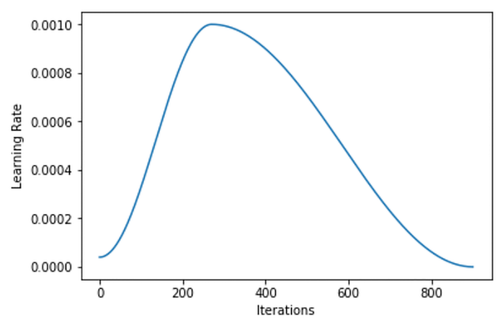\n\n6. **Mixed-precision** training with gradient scaling is implemented to speed up training on Nvidia Ampere architectures.\n\n7. Using **Wandb** for logging.\n\n8. Removed \"1.2.826.0.1.3680043.20574\" https://www.kaggle.com/competitions/rsna-2022-cervical-spine-fracture-detection/discussion/344862\n\n9. Training data is **subsampled**. E.g. we don't use all 100% samples here to avoid overfitting. To reduce overfitting try adding augmentations/regularization to your pipeline.","metadata":{"pycharm":{"name":"#%% md\n"}}},{"cell_type":"markdown","source":"
\n\n\nHere is the high level overview of the training flow:\n1. Images are loaded from train folder and transformed to `3x384x384` tensors using the same transformations used to pretrain `EfficientNet_V2_S` on ImageNet 1000.\n2. Images are passed to a pre-trained encoder of `EfficientNet_V2_S`. We ignore the final classification layer of the `EfficientNet_V2_S`, because it's shape is irrelevant given the current task. The most valuable layer of `EfficientNet_V2_S` that we'll use as a base for our final classification layer is the flattened (1280,) layer. (1280,) is then transformed to 2 parallel (7,) `Linear` layers followed by a sigmoid nonlinearity. Note that we use logits in the loss function to improve numerical stability.\n3. Vertebrae fracture targets are loaded from `train.csv` file. Vertebrae detection targets are loaded from `train_segmented.csv` which comes from PyTorch-EffNetV2 vertebrae detection (acc: 0.95). We only predict fractures that are visible on the current slice by masking fracture targets with visible vertebrae targets. Visible vertebrae targets are passed to the loss function as is without modifications.\n4. Predictions and targets are passed to BCELoss which is a muti-label loss function that optimizes 7 independent binary classification targets for C1-C7. Don't confuse this with the multiclass crossentropy loss. Additionally, we implement weighted loss for fracture targets.\n5. In the end we get a model that detects fractures and visible C1-C7 vertebrae using a single image. We need to figure out how to estimate the final result with 1 record per StudyInstanceUID, rather than 1 record per scan. We use a non-parametric model to combine predictions of base models: \n * For each StudyInstanceUID we first aggregate predictions for each of C1-C7 vertebrae by weighted averaging fracture predictions. Probabilities of vertebrae are used as weights. Example: if we are uncertain that C3 is in the slice (`C3_effnet_vert==0.1`), but we somehow predict high probability of C3 being fractured (`C3_effnet_frac==0.9`), we add it to the final aggregate with low weight `0.9 * 0.1 == 0.09`\n * We use a simple probability formula to derive `patient_overall` fracture probability. `patient_overall` is a probability of any vertebrae being fractured. It is equal to `1-no-vertebrae-are-fractured`. Under assumption of independence of vertebrae fractures we can derive the following simple equation: $P_{\\text{patient_overall}}=1-\\prod_i{[1-C_i]}$\n\n\n\n### Ideas implemented in this notebook\n\n1. Decoding **JPEG-encoded scans** along with regular scans to increase the size of training set.\n\n2. **Train-eval splitting based on patient id** (StudyInstanceUID). Using GroupKFold with patient id as a group id. This makes evaluation result more accurate as there is significant correlation between close scans from the same patient.\n\n3. **Weighted loss optimization.**. Adjusting weights of classes to optimize the same loss function as the one used in scoring of the solution.\n\n\n$$\nL_{ij} = - w_j \\left(y_{ij} \\log(p_{ij}) + (1-y_{ij}) \\log(1-p_{ij}) \\right)\n$$\n\nwhere the **weights** [are given by](https://www.kaggle.com/competitions/rsna-2022-cervical-spine-fracture-detection/discussion/340392)\n\n$$\nw_{j} = \\begin{cases}\n1, \\qquad \\text{if vertebrae negative} \\\\\n2, \\qquad \\text{if vertebrae positive} \\\\\n7, \\qquad \\text{if patient negative} \\\\\n14, \\qquad \\text{if patient positive}\n\\end{cases}\n$$\nNote, that the base EfficientNet-v2 model only uses the first two weights.\n\n4. **Accurate loss evaluation**. Evaluation using the same exact loss function used in scoring of the final solution.\n\n5. **OneCycleLR**. OneCyleLR is often the best choice of scheduler with limited compute. Read more about it here: https://sgugger.github.io/the-1cycle-policy.html\n\n\n\n6. **Mixed-precision** training with gradient scaling is implemented to speed up training on Nvidia Ampere architectures.\n\n7. Using **Wandb** for logging.\n\n8. Removed \"1.2.826.0.1.3680043.20574\" https://www.kaggle.com/competitions/rsna-2022-cervical-spine-fracture-detection/discussion/344862\n\n9. Training data is **subsampled**. E.g. we don't use all 100% samples here to avoid overfitting. To reduce overfitting try adding augmentations/regularization to your pipeline.","metadata":{"pycharm":{"name":"#%% md\n"}}},{"cell_type":"markdown","source":"\n🦴 1. Imports, constants, dependencies 🦴\n
","metadata":{"pycharm":{"name":"#%% md\n"}}},{"cell_type":"code","source":"try:\n import pylibjpeg\nexcept:\n # The following *.whl files were collected from these pip packages:\n #!pip install -U \"python-gdcm\" pydicom pylibjpeg # Required for JPEG decompression. See: https://www.kaggle.com/competitions/rsna-2022-cervical-spine-fracture-detection/discussion/341412\n #!pip install -U torchvision # For EfficientNetV2\n\n # Offline dependencies:\n !mkdir -p /root/.cache/torch/hub/checkpoints/\n !cp ../input/rsna-2022-whl/efficientnet_v2_s-dd5fe13b.pth /root/.cache/torch/hub/checkpoints/\n !pip install /kaggle/input/rsna-2022-whl/{pydicom-2.3.0-py3-none-any.whl,pylibjpeg-1.4.0-py3-none-any.whl,python_gdcm-3.0.15-cp37-cp37m-manylinux_2_17_x86_64.manylinux2014_x86_64.whl}\n !pip install /kaggle/input/rsna-2022-whl/{torch-1.12.1-cp37-cp37m-manylinux1_x86_64.whl,torchvision-0.13.1-cp37-cp37m-manylinux1_x86_64.whl}","metadata":{"pycharm":{"name":"#%%\n"},"execution":{"iopub.status.busy":"2022-08-28T14:59:22.954711Z","iopub.execute_input":"2022-08-28T14:59:22.955396Z","iopub.status.idle":"2022-08-28T14:59:22.96846Z","shell.execute_reply.started":"2022-08-28T14:59:22.955361Z","shell.execute_reply":"2022-08-28T14:59:22.96722Z"},"trusted":true},"execution_count":null,"outputs":[]},{"cell_type":"code","source":"import gc\nimport glob\nimport os\nimport re\n\nimport cv2\nimport matplotlib.pyplot as plt\nimport numpy as np\nimport pandas as pd\nimport pydicom as dicom\nimport torch\nimport torchvision as tv\nfrom sklearn.model_selection import GroupKFold\nfrom torch.cuda.amp import GradScaler, autocast\nfrom torchvision.models.feature_extraction import create_feature_extractor\nfrom tqdm.notebook import tqdm\n\nimport wandb\n\nplt.rcParams['figure.figsize'] = (20, 5)\npd.set_option('display.max_rows', 100)\npd.set_option('display.max_columns', 1000)\n\n# Effnet\nWEIGHTS = tv.models.efficientnet.EfficientNet_V2_S_Weights.DEFAULT\nRSNA_2022_PATH = '../input/rsna-2022-cervical-spine-fracture-detection'\nTRAIN_IMAGES_PATH = f'{RSNA_2022_PATH}/train_images'\nTEST_IMAGES_PATH = f'{RSNA_2022_PATH}/test_images'\nEFFNET_MAX_TRAIN_BATCHES = 4000\nEFFNET_MAX_EVAL_BATCHES = 200\nONE_CYCLE_MAX_LR = 0.0001\nONE_CYCLE_PCT_START = 0.3\nSAVE_CHECKPOINT_EVERY_STEP = 1000\nEFFNET_CHECKPOINTS_PATH = '../input/rsna-2022-base-effnetv2'\nFRAC_LOSS_WEIGHT = 2.\nN_FOLDS = 5\nMETADATA_PATH = '../input/vertebrae-detection-checkpoints'\n\nPREDICT_MAX_BATCHES = 1e9\n\n# Common\ntry:\n from kaggle_secrets import UserSecretsClient\n IS_KAGGLE = True\nexcept:\n IS_KAGGLE = False\n\nos.environ[\"WANDB_MODE\"] = \"online\"\nif os.environ[\"WANDB_MODE\"] == \"online\":\n if IS_KAGGLE:\n os.environ['WANDB_API_KEY'] = UserSecretsClient().get_secret(\"WANDB_API_KEY\")\n\nif not IS_KAGGLE:\n print('Running locally')\n RSNA_2022_PATH = '/mnt/rsna2022'\n TRAIN_IMAGES_PATH = '/mnt/rsna2022/train_images'\n TEST_IMAGES_PATH = '/mnt/rsna2022/test_images'\n METADATA_PATH = '/home/vslaykovsky/Downloads/'\n EFFNET_CHECKPOINTS_PATH = 'frac_checkpoints'\n os.environ['WANDB_API_KEY'] = 'yourkeyhere'\n\nDEVICE = 'cuda' if torch.cuda.is_available() else 'cpu'\nif DEVICE == 'cuda':\n BATCH_SIZE = 32\nelse:\n BATCH_SIZE = 2\n","metadata":{"pycharm":{"name":"#%%\n"},"execution":{"iopub.status.busy":"2022-08-28T14:59:22.971449Z","iopub.execute_input":"2022-08-28T14:59:22.972611Z","iopub.status.idle":"2022-08-28T14:59:23.521649Z","shell.execute_reply.started":"2022-08-28T14:59:22.972508Z","shell.execute_reply":"2022-08-28T14:59:23.520569Z"},"trusted":true},"execution_count":null,"outputs":[]},{"cell_type":"markdown","source":"\n 🦴 2. Loading train/eval/test dataframes 🦴\n
","metadata":{"pycharm":{"name":"#%% md\n"}}},{"cell_type":"markdown","source":"### Train data\n\n1. Loading data from competition dataset folder `../input/rsna-2022-cervical-spine-fracture-detection/train.csv`\n2. Joining data with slice information from metadata dataset `../input/rsna-2022-spine-fracture-detection-metadata/meta_train_with_vertebrae.csv`\n3. Adding `Splits` column to facilitate train/eval splits.","metadata":{"pycharm":{"name":"#%% md\n"}}},{"cell_type":"code","source":"df_train = pd.read_csv(f'{RSNA_2022_PATH}/train.csv')\ndf_train.sample(2)","metadata":{"pycharm":{"name":"#%%\n"},"execution":{"iopub.status.busy":"2022-08-28T14:59:23.524238Z","iopub.execute_input":"2022-08-28T14:59:23.524949Z","iopub.status.idle":"2022-08-28T14:59:23.545663Z","shell.execute_reply.started":"2022-08-28T14:59:23.524909Z","shell.execute_reply":"2022-08-28T14:59:23.544796Z"},"trusted":true},"execution_count":null,"outputs":[]},{"cell_type":"code","source":"# rsna-2022-spine-fracture-detection-metadata contains inference of C1-C7 vertebrae for all training sample (95% accuracy)\ndf_train_slices = pd.read_csv(f'{METADATA_PATH}/train_segmented.csv')\nc1c7 = [f'C{i}' for i in range(1, 8)]\ndf_train_slices[c1c7] = (df_train_slices[c1c7] > 0.5).astype(int)\nprint(df_train_slices.sample(5)[['StudyInstanceUID', 'C1', 'C2', 'C3', 'C4', 'C5', 'C6', 'C7']].to_markdown())","metadata":{"_cell_guid":"b1076dfc-b9ad-4769-8c92-a6c4dae69d19","_uuid":"8f2839f25d086af736a60e9eeb907d3b93b6e0e5","pycharm":{"name":"#%%\n"},"execution":{"iopub.status.busy":"2022-08-28T14:59:23.54715Z","iopub.execute_input":"2022-08-28T14:59:23.547789Z","iopub.status.idle":"2022-08-28T14:59:24.65183Z","shell.execute_reply.started":"2022-08-28T14:59:23.547755Z","shell.execute_reply":"2022-08-28T14:59:24.650863Z"},"trusted":true},"execution_count":null,"outputs":[]},{"cell_type":"code","source":"df_train = df_train_slices.set_index('StudyInstanceUID').join(df_train.set_index('StudyInstanceUID'),\n rsuffix='_fracture').reset_index().copy()\ndf_train = df_train.query('StudyInstanceUID != \"1.2.826.0.1.3680043.20574\"').reset_index(drop=True)\ndf_train.sample(2)","metadata":{"pycharm":{"name":"#%%\n"},"execution":{"iopub.status.busy":"2022-08-28T14:59:24.654324Z","iopub.execute_input":"2022-08-28T14:59:24.654768Z","iopub.status.idle":"2022-08-28T14:59:25.469453Z","shell.execute_reply.started":"2022-08-28T14:59:24.654731Z","shell.execute_reply":"2022-08-28T14:59:25.468396Z"},"trusted":true},"execution_count":null,"outputs":[]},{"cell_type":"code","source":"split = GroupKFold(N_FOLDS)\nfor k, (_, test_idx) in enumerate(split.split(df_train, groups=df_train.StudyInstanceUID)):\n df_train.loc[test_idx, 'split'] = k\ndf_train.sample(2)","metadata":{"pycharm":{"name":"#%%\n"},"execution":{"iopub.status.busy":"2022-08-28T14:59:25.471853Z","iopub.execute_input":"2022-08-28T14:59:25.472526Z","iopub.status.idle":"2022-08-28T14:59:25.927771Z","shell.execute_reply.started":"2022-08-28T14:59:25.47249Z","shell.execute_reply":"2022-08-28T14:59:25.926755Z"},"trusted":true},"execution_count":null,"outputs":[]},{"cell_type":"markdown","source":"### Test data\n\n1. Loading data from competition dataset folder `../input/rsna-2022-cervical-spine-fracture-detection/test.csv`\n2. Joining data with slice information collected from test image folders `../input/rsna-2022-cervical-spine-fracture-detection/test_images/*/*`","metadata":{"pycharm":{"name":"#%% md\n"}}},{"cell_type":"code","source":"df_test = pd.read_csv(f'{RSNA_2022_PATH}/test.csv')\n\nif df_test.iloc[0].row_id == '1.2.826.0.1.3680043.10197_C1':\n # test_images and test.csv are inconsistent in the dev dataset, fixing labels for the dev run.\n df_test = pd.DataFrame({\n \"row_id\": ['1.2.826.0.1.3680043.22327_C1', '1.2.826.0.1.3680043.25399_C1', '1.2.826.0.1.3680043.5876_C1'],\n \"StudyInstanceUID\": ['1.2.826.0.1.3680043.22327', '1.2.826.0.1.3680043.25399', '1.2.826.0.1.3680043.5876'],\n \"prediction_type\": [\"C1\", \"C1\", \"patient_overall\"]}\n )\n\ndf_test","metadata":{"pycharm":{"name":"#%%\n"},"execution":{"iopub.status.busy":"2022-08-28T14:59:25.92921Z","iopub.execute_input":"2022-08-28T14:59:25.929771Z","iopub.status.idle":"2022-08-28T14:59:25.948264Z","shell.execute_reply.started":"2022-08-28T14:59:25.929734Z","shell.execute_reply":"2022-08-28T14:59:25.94735Z"},"trusted":true},"execution_count":null,"outputs":[]},{"cell_type":"code","source":"test_slices = glob.glob(f'{TEST_IMAGES_PATH}/*/*')\ntest_slices = [re.findall(f'{TEST_IMAGES_PATH}/(.*)/(.*).dcm', s)[0] for s in test_slices]\ndf_test_slices = pd.DataFrame(data=test_slices, columns=['StudyInstanceUID', 'Slice'])\ndf_test_slices.sample(2)","metadata":{"pycharm":{"name":"#%%\n"},"execution":{"iopub.status.busy":"2022-08-28T14:59:25.949828Z","iopub.execute_input":"2022-08-28T14:59:25.950215Z","iopub.status.idle":"2022-08-28T14:59:25.974238Z","shell.execute_reply.started":"2022-08-28T14:59:25.950177Z","shell.execute_reply":"2022-08-28T14:59:25.97322Z"},"trusted":true},"execution_count":null,"outputs":[]},{"cell_type":"code","source":"df_test = df_test.set_index('StudyInstanceUID').join(df_test_slices.set_index('StudyInstanceUID')).reset_index()\ndf_test.sample(2)","metadata":{"pycharm":{"name":"#%%\n"},"execution":{"iopub.status.busy":"2022-08-28T14:59:25.976708Z","iopub.execute_input":"2022-08-28T14:59:25.977795Z","iopub.status.idle":"2022-08-28T14:59:25.99397Z","shell.execute_reply.started":"2022-08-28T14:59:25.977759Z","shell.execute_reply":"2022-08-28T14:59:25.992985Z"},"trusted":true},"execution_count":null,"outputs":[]},{"cell_type":"markdown","source":"\n 🦴 3. Dataset class 🦴\n
\n\n`EffnetDataSet` class returns images of individual slices. It uses a dataframe parameter `df` as a source of slices metadata to locate and load images from `path` folder. It accepts transforms parameter which we set to `WEIGHTS.transforms()`. This is a set of transforms used to pre-train the model on ImageNet dataset.","metadata":{"pycharm":{"name":"#%% md\n"}}},{"cell_type":"code","source":"def load_dicom(path):\n \"\"\"\n This supports loading both regular and compressed JPEG images. \n See the first sell with `pip install` commands for the necessary dependencies\n \"\"\"\n img = dicom.dcmread(path)\n img.PhotometricInterpretation = 'YBR_FULL'\n data = img.pixel_array\n data = data - np.min(data)\n if np.max(data) != 0:\n data = data / np.max(data)\n data = (data * 255).astype(np.uint8)\n return cv2.cvtColor(data, cv2.COLOR_GRAY2RGB), img\n\n\nim, meta = load_dicom(\n f'{TRAIN_IMAGES_PATH}/1.2.826.0.1.3680043.10001/1.dcm')\nplt.figure()\nplt.imshow(im)\nplt.title('regular image')\n\nim, meta = load_dicom(\n f'{TRAIN_IMAGES_PATH}/1.2.826.0.1.3680043.10014/1.dcm')\nplt.figure()\nplt.imshow(im)\nplt.title('jpeg')","metadata":{"pycharm":{"name":"#%%\n"},"execution":{"iopub.status.busy":"2022-08-28T14:59:25.995666Z","iopub.execute_input":"2022-08-28T14:59:25.996035Z","iopub.status.idle":"2022-08-28T14:59:26.476736Z","shell.execute_reply.started":"2022-08-28T14:59:25.996001Z","shell.execute_reply":"2022-08-28T14:59:26.475705Z"},"trusted":true},"execution_count":null,"outputs":[]},{"cell_type":"code","source":"class EffnetDataSet(torch.utils.data.Dataset):\n def __init__(self, df, path, transforms=None):\n super().__init__()\n self.df = df\n self.path = path\n self.transforms = transforms\n\n def __getitem__(self, i):\n path = os.path.join(self.path, self.df.iloc[i].StudyInstanceUID, f'{self.df.iloc[i].Slice}.dcm')\n\n try:\n img = load_dicom(path)[0]\n # Pytorch uses (batch, channel, height, width) order. Converting (height, width, channel) -> (channel, height, width)\n img = np.transpose(img, (2, 0, 1))\n if self.transforms is not None:\n img = self.transforms(torch.as_tensor(img))\n except Exception as ex:\n print(ex)\n return None\n\n if 'C1_fracture' in self.df:\n frac_targets = torch.as_tensor(self.df.iloc[i][['C1_fracture', 'C2_fracture', 'C3_fracture', 'C4_fracture',\n 'C5_fracture', 'C6_fracture', 'C7_fracture']].astype(\n 'float32').values)\n vert_targets = torch.as_tensor(\n self.df.iloc[i][['C1', 'C2', 'C3', 'C4', 'C5', 'C6', 'C7']].astype('float32').values)\n frac_targets = frac_targets * vert_targets # we only enable targets that are visible on the current slice\n return img, frac_targets, vert_targets\n return img\n\n def __len__(self):\n return len(self.df)\n","metadata":{"pycharm":{"name":"#%%\n"},"execution":{"iopub.status.busy":"2022-08-28T14:59:26.481229Z","iopub.execute_input":"2022-08-28T14:59:26.481518Z","iopub.status.idle":"2022-08-28T14:59:26.492196Z","shell.execute_reply.started":"2022-08-28T14:59:26.481491Z","shell.execute_reply":"2022-08-28T14:59:26.491059Z"},"trusted":true},"execution_count":null,"outputs":[]},{"cell_type":"code","source":"ds_train = EffnetDataSet(df_train, TRAIN_IMAGES_PATH, WEIGHTS.transforms())\nX, y_frac, y_vert = ds_train[42]\nprint(X.shape, y_frac.shape, y_vert.shape)","metadata":{"pycharm":{"name":"#%%\n"},"execution":{"iopub.status.busy":"2022-08-28T14:59:26.494083Z","iopub.execute_input":"2022-08-28T14:59:26.494627Z","iopub.status.idle":"2022-08-28T14:59:26.522921Z","shell.execute_reply.started":"2022-08-28T14:59:26.494585Z","shell.execute_reply":"2022-08-28T14:59:26.521876Z"},"trusted":true},"execution_count":null,"outputs":[]},{"cell_type":"code","source":"def plot_sample_patient(df, ds):\n patient = np.random.choice(df.query('patient_overall > 0').StudyInstanceUID)\n df = df.query('StudyInstanceUID == @patient')\n display(df)\n\n frac = np.stack([ds[i][1] for i in df.index])\n vert = np.stack([ds[i][2] for i in df.index])\n ax = plt.subplot(1, 2, 1)\n ax.plot(frac)\n ax.set_title(f'Vertebrae with fractures by slice (masked by visible vertebrae). uid:{patient}')\n ax = plt.subplot(1, 2, 2)\n ax.set_title(f'Visible vertebrae by slice. uid:{patient}')\n ax.plot(vert)\n\nplot_sample_patient(df_train, ds_train)","metadata":{"pycharm":{"name":"#%%\n"},"execution":{"iopub.status.busy":"2022-08-28T14:59:26.524652Z","iopub.execute_input":"2022-08-28T14:59:26.525016Z","iopub.status.idle":"2022-08-28T14:59:36.201293Z","shell.execute_reply.started":"2022-08-28T14:59:26.524981Z","shell.execute_reply":"2022-08-28T14:59:36.198888Z"},"trusted":true},"execution_count":null,"outputs":[]},{"cell_type":"code","source":"# Only X values returned by the test dataset\nds_test = EffnetDataSet(df_test, TEST_IMAGES_PATH, WEIGHTS.transforms())\nX = ds_test[42]\nX.shape","metadata":{"pycharm":{"name":"#%%\n"},"execution":{"iopub.status.busy":"2022-08-28T14:59:36.205525Z","iopub.execute_input":"2022-08-28T14:59:36.207823Z","iopub.status.idle":"2022-08-28T14:59:36.239716Z","shell.execute_reply.started":"2022-08-28T14:59:36.207769Z","shell.execute_reply":"2022-08-28T14:59:36.238483Z"},"trusted":true},"execution_count":null,"outputs":[]},{"cell_type":"markdown","source":"\n 🦴 4. Model 🦴\n
\n\n\nIn Pytorch we use create_feature_extractor to access feature layers of pre-existing models. Final flat layer of `efficientnet_v2_s` model is called `flatten`. We'll build our classification layer on top of it. ","metadata":{"pycharm":{"name":"#%% md\n"}}},{"cell_type":"code","source":"class EffnetModel(torch.nn.Module):\n def __init__(self):\n super().__init__()\n effnet = tv.models.efficientnet_v2_s(weights=WEIGHTS)\n self.model = create_feature_extractor(effnet, ['flatten'])\n self.nn_fracture = torch.nn.Sequential(\n torch.nn.Linear(1280, 7),\n )\n self.nn_vertebrae = torch.nn.Sequential(\n torch.nn.Linear(1280, 7),\n )\n\n def forward(self, x):\n # returns logits\n x = self.model(x)['flatten']\n return self.nn_fracture(x), self.nn_vertebrae(x)\n\n def predict(self, x):\n frac, vert = self.forward(x)\n return torch.sigmoid(frac), torch.sigmoid(vert)\n\nmodel = EffnetModel()\nmodel.predict(torch.randn(1, 3, 512, 512))\ndel model","metadata":{"pycharm":{"name":"#%%\n"},"execution":{"iopub.status.busy":"2022-08-28T14:59:36.243452Z","iopub.execute_input":"2022-08-28T14:59:36.244341Z","iopub.status.idle":"2022-08-28T14:59:38.655174Z","shell.execute_reply.started":"2022-08-28T14:59:36.244306Z","shell.execute_reply":"2022-08-28T14:59:38.654084Z"},"trusted":true},"execution_count":null,"outputs":[]},{"cell_type":"markdown","source":"\n 🦴 5.1 Train: loss function 🦴\n
\n\nWe use weighted loss here. See definition here: https://www.kaggle.com/competitions/rsna-2022-cervical-spine-fracture-detection/discussion/340392\nWeighted loss helps us to optimize the same target that is used in the final scoring.\n\nAuxiliary vertebrae detection loss is added in the training/evaluation loop to improve model's performance.","metadata":{"pycharm":{"name":"#%% md\n"}}},{"cell_type":"code","source":"def weighted_loss(y_pred_logit, y, reduction='mean', verbose=False):\n \"\"\"\n Weighted loss\n We reuse torch.nn.functional.binary_cross_entropy_with_logits here. pos_weight and weights combined give us necessary coefficients described in https://www.kaggle.com/competitions/rsna-2022-cervical-spine-fracture-detection/discussion/340392\n\n See also this explanation: https://www.kaggle.com/code/samuelcortinhas/rsna-fracture-detection-in-depth-eda/notebook\n \"\"\"\n\n neg_weights = (torch.tensor([7., 1, 1, 1, 1, 1, 1, 1]) if y_pred_logit.shape[-1] == 8 else torch.ones(y_pred_logit.shape[-1])).to(DEVICE)\n pos_weights = (torch.tensor([14., 2, 2, 2, 2, 2, 2, 2]) if y_pred_logit.shape[-1] == 8 else torch.ones(y_pred_logit.shape[-1]) * 2.).to(DEVICE)\n\n loss = torch.nn.functional.binary_cross_entropy_with_logits(\n y_pred_logit,\n y,\n reduction='none',\n )\n\n if verbose:\n print('loss', loss)\n\n pos_weights = y * pos_weights.unsqueeze(0)\n neg_weights = (1 - y) * neg_weights.unsqueeze(0)\n all_weights = pos_weights + neg_weights\n\n if verbose:\n print('all weights', all_weights)\n\n loss *= all_weights\n if verbose:\n print('weighted loss', loss)\n\n norm = torch.sum(all_weights, dim=1).unsqueeze(1)\n if verbose:\n print('normalization factors', norm)\n\n loss /= norm\n if verbose:\n print('normalized loss', loss)\n\n loss = torch.sum(loss, dim=1)\n if verbose:\n print('summed up over patient_overall-C1-C7 loss', loss)\n\n if reduction == 'mean':\n return torch.mean(loss)\n return loss","metadata":{"pycharm":{"name":"#%%\n"},"execution":{"iopub.status.busy":"2022-08-28T14:59:38.656783Z","iopub.execute_input":"2022-08-28T14:59:38.657179Z","iopub.status.idle":"2022-08-28T14:59:38.66975Z","shell.execute_reply.started":"2022-08-28T14:59:38.65714Z","shell.execute_reply":"2022-08-28T14:59:38.668795Z"},"trusted":true},"execution_count":null,"outputs":[]},{"cell_type":"code","source":"# Quick test of patient_overall + C1-C7 loss\nweighted_loss(\n torch.logit(torch.tensor([\n [0.1, 0.9, 0.1, 0.1, 0.1, 0.1, 0.1, 0.1],\n [0.1, 0.9, 0.1, 0.1, 0.1, 0.1, 0.1, 0.1]\n ])).to(DEVICE),\n torch.tensor([\n [1., 1., 0., 0., 0., 0., 0., 0.],\n [0., 0, 0., 0., 0., 0., 0., 0.]\n ]).to(DEVICE),\n reduction=None,\n verbose=True\n)","metadata":{"pycharm":{"name":"#%%\n"},"execution":{"iopub.status.busy":"2022-08-28T14:59:38.671273Z","iopub.execute_input":"2022-08-28T14:59:38.672376Z","iopub.status.idle":"2022-08-28T14:59:38.693187Z","shell.execute_reply.started":"2022-08-28T14:59:38.672335Z","shell.execute_reply":"2022-08-28T14:59:38.692111Z"},"trusted":true},"execution_count":null,"outputs":[]},{"cell_type":"code","source":"# Quick test of C1-C7 loss\nweighted_loss(\n torch.logit(torch.tensor([\n [0.9, 0.1, 0.1, 0.1, 0.1, 0.1, 0.1],\n [0.9, 0.1, 0.1, 0.1, 0.1, 0.1, 0.1]\n ])).to(DEVICE),\n torch.tensor([\n [1., 0., 0., 0., 0., 0., 0.],\n [0, 0., 0., 0., 0., 0., 0.]\n ]).to(DEVICE),\n reduction=None,\n verbose=True\n)","metadata":{"pycharm":{"name":"#%%\n"},"execution":{"iopub.status.busy":"2022-08-28T14:59:38.694649Z","iopub.execute_input":"2022-08-28T14:59:38.695075Z","iopub.status.idle":"2022-08-28T14:59:38.713637Z","shell.execute_reply.started":"2022-08-28T14:59:38.695041Z","shell.execute_reply":"2022-08-28T14:59:38.712674Z"},"trusted":true},"execution_count":null,"outputs":[]},{"cell_type":"markdown","source":"\n 🦴 5.2 Train: training/evaluation loop 🦴\n
","metadata":{"pycharm":{"name":"#%% md\n"}}},{"cell_type":"code","source":"def filter_nones(b):\n return torch.utils.data.default_collate([v for v in b if v is not None])","metadata":{"pycharm":{"name":"#%%\n"},"execution":{"iopub.status.busy":"2022-08-28T14:59:38.714952Z","iopub.execute_input":"2022-08-28T14:59:38.715455Z","iopub.status.idle":"2022-08-28T14:59:38.720968Z","shell.execute_reply.started":"2022-08-28T14:59:38.71542Z","shell.execute_reply":"2022-08-28T14:59:38.719934Z"},"trusted":true},"execution_count":null,"outputs":[]},{"cell_type":"code","source":"def save_model(name, model):\n torch.save(model.state_dict(), f'{name}.tph')","metadata":{"pycharm":{"name":"#%%\n"},"execution":{"iopub.status.busy":"2022-08-28T14:59:38.722394Z","iopub.execute_input":"2022-08-28T14:59:38.723982Z","iopub.status.idle":"2022-08-28T14:59:38.730438Z","shell.execute_reply.started":"2022-08-28T14:59:38.723921Z","shell.execute_reply":"2022-08-28T14:59:38.729241Z"},"trusted":true},"execution_count":null,"outputs":[]},{"cell_type":"code","source":"def load_model(model, name, path='.'):\n data = torch.load(os.path.join(path, f'{name}.tph'), map_location=DEVICE)\n model.load_state_dict(data)\n return model\n\n\n# quick test\nmodel = torch.nn.Linear(2, 1)\nsave_model('testmodel', model)\n\nmodel1 = load_model(torch.nn.Linear(2, 1), 'testmodel')\nassert torch.all(\n next(iter(model1.parameters())) == next(iter(model.parameters()))\n).item(), \"Loading/saving is inconsistent!\"","metadata":{"pycharm":{"name":"#%%\n"},"execution":{"iopub.status.busy":"2022-08-28T14:59:38.73191Z","iopub.execute_input":"2022-08-28T14:59:38.732477Z","iopub.status.idle":"2022-08-28T14:59:38.743026Z","shell.execute_reply.started":"2022-08-28T14:59:38.732437Z","shell.execute_reply":"2022-08-28T14:59:38.742063Z"},"trusted":true},"execution_count":null,"outputs":[]},{"cell_type":"code","source":"def evaluate_effnet(model: EffnetModel, ds, max_batches=PREDICT_MAX_BATCHES, shuffle=False):\n torch.manual_seed(42)\n model = model.to(DEVICE)\n dl_test = torch.utils.data.DataLoader(ds, batch_size=BATCH_SIZE, shuffle=shuffle, num_workers=os.cpu_count(),\n collate_fn=filter_nones)\n pred_frac = []\n pred_vert = []\n with torch.no_grad():\n model.eval()\n frac_losses = []\n vert_losses = []\n with tqdm(dl_test, desc='Eval', miniters=10) as progress:\n for i, (X, y_frac, y_vert) in enumerate(progress):\n with autocast():\n y_frac_pred, y_vert_pred = model.forward(X.to(DEVICE))\n frac_loss = weighted_loss(y_frac_pred, y_frac.to(DEVICE)).item()\n vert_loss = torch.nn.functional.binary_cross_entropy_with_logits(y_vert_pred, y_vert.to(DEVICE)).item()\n pred_frac.append(torch.sigmoid(y_frac_pred))\n pred_vert.append(torch.sigmoid(y_vert_pred))\n frac_losses.append(frac_loss)\n vert_losses.append(vert_loss)\n\n if i >= max_batches:\n break\n return np.mean(frac_losses), np.mean(vert_losses), torch.concat(pred_frac).cpu().numpy(), torch.concat(pred_vert).cpu().numpy()\n\n# quick test\nm = EffnetModel()\nfrac_loss, vert_loss, pred1, pred2 = evaluate_effnet(m, ds_train, max_batches=2)\nfrac_loss, vert_loss, pred1.shape, pred2.shape","metadata":{"pycharm":{"name":"#%%\n"},"execution":{"iopub.status.busy":"2022-08-28T14:59:38.74563Z","iopub.execute_input":"2022-08-28T14:59:38.746912Z","iopub.status.idle":"2022-08-28T14:59:42.456926Z","shell.execute_reply.started":"2022-08-28T14:59:38.746885Z","shell.execute_reply":"2022-08-28T14:59:42.45564Z"},"trusted":true},"execution_count":null,"outputs":[]},{"cell_type":"code","source":"def gc_collect():\n gc.collect()\n torch.cuda.empty_cache()","metadata":{"pycharm":{"name":"#%%\n"},"execution":{"iopub.status.busy":"2022-08-28T14:59:42.459242Z","iopub.execute_input":"2022-08-28T14:59:42.459959Z","iopub.status.idle":"2022-08-28T14:59:42.46538Z","shell.execute_reply.started":"2022-08-28T14:59:42.459916Z","shell.execute_reply":"2022-08-28T14:59:42.464287Z"},"trusted":true},"execution_count":null,"outputs":[]},{"cell_type":"code","source":"%%wandb\n# inline wandb diagrams!\n\ndef train_effnet(ds_train, ds_eval, logger, name):\n torch.manual_seed(42)\n dl_train = torch.utils.data.DataLoader(ds_train, batch_size=BATCH_SIZE, shuffle=True, num_workers=os.cpu_count(),\n collate_fn=filter_nones)\n\n model = EffnetModel().to(DEVICE)\n optim = torch.optim.Adam(model.parameters())\n scheduler = torch.optim.lr_scheduler.OneCycleLR(optim, max_lr=ONE_CYCLE_MAX_LR, epochs=1,\n steps_per_epoch=min(EFFNET_MAX_TRAIN_BATCHES, len(dl_train)),\n pct_start=ONE_CYCLE_PCT_START)\n\n model.train()\n scaler = GradScaler()\n with tqdm(dl_train, desc='Train', miniters=10) as progress:\n for batch_idx, (X, y_frac, y_vert) in enumerate(progress):\n\n if ds_eval is not None and batch_idx % SAVE_CHECKPOINT_EVERY_STEP == 0 and EFFNET_MAX_EVAL_BATCHES > 0:\n frac_loss, vert_loss = evaluate_effnet(\n model, ds_eval, max_batches=EFFNET_MAX_EVAL_BATCHES, shuffle=True)[:2]\n model.train()\n logger.log(\n {'eval_frac_loss': frac_loss, 'eval_vert_loss': vert_loss, 'eval_loss': frac_loss + vert_loss})\n if batch_idx > 0: # don't save untrained model\n save_model(name, model)\n\n if batch_idx >= EFFNET_MAX_TRAIN_BATCHES:\n break\n\n optim.zero_grad()\n # Using mixed precision training\n with autocast():\n y_frac_pred, y_vert_pred = model.forward(X.to(DEVICE))\n frac_loss = weighted_loss(y_frac_pred, y_frac.to(DEVICE))\n vert_loss = torch.nn.functional.binary_cross_entropy_with_logits(y_vert_pred, y_vert.to(DEVICE))\n loss = FRAC_LOSS_WEIGHT * frac_loss + vert_loss\n\n if np.isinf(loss.item()) or np.isnan(loss.item()):\n print(f'Bad loss, skipping the batch {batch_idx}')\n del loss, frac_loss, vert_loss, y_frac_pred, y_vert_pred\n gc_collect()\n continue\n\n # scaler is needed to prevent \"gradient underflow\"\n scaler.scale(loss).backward()\n scaler.step(optim)\n scaler.update()\n scheduler.step()\n\n progress.set_description(f'Train loss: {loss.item() :.02f}')\n logger.log({'loss': (loss.item()), 'frac_loss': frac_loss.item(), 'vert_loss': vert_loss.item(),\n 'lr': scheduler.get_last_lr()[0]})\n\n save_model(name, model)\n return model\n\n\n# N-fold models. Can be used to estimate accurate CV score and in ensembled submissions.\neffnet_models = []\nfor fold in range(N_FOLDS):\n if os.path.exists(os.path.join(EFFNET_CHECKPOINTS_PATH, f'effnetv2-f{fold}.tph')):\n print(f'Found cached version of effnetv2-f{fold}')\n effnet_models.append(load_model(EffnetModel(), f'effnetv2-f{fold}', EFFNET_CHECKPOINTS_PATH))\n else:\n with wandb.init(project='RSNA-2022', name=f'EffNet-v2-fold{fold}') as run:\n gc_collect()\n ds_train = EffnetDataSet(df_train.query('split != @fold'), TRAIN_IMAGES_PATH, WEIGHTS.transforms())\n ds_eval = EffnetDataSet(df_train.query('split == @fold'), TRAIN_IMAGES_PATH, WEIGHTS.transforms())\n effnet_models.append(train_effnet(ds_train, ds_eval, run, f'effnetv2-f{fold}'))\n\n# \"Main\" model that uses all folds data. Can be used in single-model submissions.\nif os.path.exists(os.path.join(EFFNET_CHECKPOINTS_PATH, f'effnetv2.tph')):\n print(f'Found cached version of effnetv2')\n effnet_models.append(load_model(EffnetModel(), f'effnetv2', EFFNET_CHECKPOINTS_PATH))\nelse:\n with wandb.init(project='RSNA-2022', name=f'EffNet-v2') as run:\n gc_collect()\n ds_train = EffnetDataSet(df_train, TRAIN_IMAGES_PATH, WEIGHTS.transforms())\n train_effnet(ds_train, None, run, f'effnetv2')\n","metadata":{"pycharm":{"name":"#%%\n"},"execution":{"iopub.status.busy":"2022-08-28T14:59:42.466935Z","iopub.execute_input":"2022-08-28T14:59:42.467395Z","iopub.status.idle":"2022-08-28T14:59:52.619661Z","shell.execute_reply.started":"2022-08-28T14:59:42.467261Z","shell.execute_reply":"2022-08-28T14:59:52.618682Z"},"trusted":true},"execution_count":null,"outputs":[]},{"cell_type":"markdown","source":" ","metadata":{}},{"cell_type":"markdown","source":"
\n 🦴 6. Evaluation 🦴\n
\n\nWe cross-validate our final model here using 5 folds.\n1. We generate prediction for every holdout set for every fold.\n2. Predictions are aggregated using the non-parametric model.\n3. Final results are produced using the `weighted_loss`","metadata":{"pycharm":{"name":"#%% md\n"}}},{"cell_type":"code","source":"effnet_models = []\nfor name in tqdm(range(N_FOLDS)):\n effnet_models.append(load_model(EffnetModel(), f'effnetv2-f{name}', EFFNET_CHECKPOINTS_PATH))","metadata":{"pycharm":{"name":"#%%\n"},"execution":{"iopub.status.busy":"2022-08-28T14:59:52.623212Z","iopub.execute_input":"2022-08-28T14:59:52.623514Z","iopub.status.idle":"2022-08-28T14:59:57.705709Z","shell.execute_reply.started":"2022-08-28T14:59:52.623486Z","shell.execute_reply":"2022-08-28T14:59:57.704693Z"},"trusted":true},"execution_count":null,"outputs":[]},{"cell_type":"code","source":"def gen_effnet_predictions(effnet_models, df_train):\n if os.path.exists(os.path.join(EFFNET_CHECKPOINTS_PATH, 'train_predictions.csv')):\n print('Found cached version of train_predictions.csv')\n df_train_predictions = pd.read_csv(os.path.join(EFFNET_CHECKPOINTS_PATH, 'train_predictions.csv'))\n else:\n df_train_predictions = []\n with tqdm(enumerate(effnet_models), total=len(effnet_models), desc='Folds') as progress:\n for fold, effnet_model in progress:\n ds_eval = EffnetDataSet(df_train.query('split == @fold'), TRAIN_IMAGES_PATH, WEIGHTS.transforms())\n\n frac_loss, vert_loss, effnet_pred_frac, effnet_pred_vert = evaluate_effnet(effnet_model, ds_eval, PREDICT_MAX_BATCHES)\n progress.set_description(f'Fold score:{frac_loss:.02f}')\n df_effnet_pred = pd.DataFrame(data=np.concatenate([effnet_pred_frac, effnet_pred_vert], axis=1),\n columns=[f'C{i}_effnet_frac' for i in range(1, 8)] +\n [f'C{i}_effnet_vert' for i in range(1, 8)])\n\n df = pd.concat(\n [df_train.query('split == @fold').head(len(df_effnet_pred)).reset_index(drop=True), df_effnet_pred],\n axis=1\n ).sort_values(['StudyInstanceUID', 'Slice'])\n df_train_predictions.append(df)\n df_train_predictions = pd.concat(df_train_predictions)\n return df_train_predictions","metadata":{"pycharm":{"name":"#%%\n"},"execution":{"iopub.status.busy":"2022-08-28T14:59:57.707433Z","iopub.execute_input":"2022-08-28T14:59:57.708068Z","iopub.status.idle":"2022-08-28T14:59:57.724244Z","shell.execute_reply.started":"2022-08-28T14:59:57.708029Z","shell.execute_reply":"2022-08-28T14:59:57.723119Z"},"trusted":true},"execution_count":null,"outputs":[]},{"cell_type":"code","source":"df_pred = gen_effnet_predictions(effnet_models, df_train)\ndf_pred.to_csv('train_predictions.csv', index=False)\ndf_pred","metadata":{"pycharm":{"name":"#%%\n","is_executing":true},"execution":{"iopub.status.busy":"2022-08-28T14:59:57.725566Z","iopub.execute_input":"2022-08-28T14:59:57.726598Z","iopub.status.idle":"2022-08-28T15:00:13.383646Z","shell.execute_reply.started":"2022-08-28T14:59:57.726562Z","shell.execute_reply":"2022-08-28T15:00:13.382688Z"},"trusted":true},"execution_count":null,"outputs":[]},{"cell_type":"code","source":"def plot_sample_patient(df_pred):\n patient = np.random.choice(df_pred.StudyInstanceUID)\n df = df_pred.query('StudyInstanceUID == @patient').reset_index()\n\n plt.subplot(1, 3, 1).plot((df[[f'C{i}_fracture' for i in range(1, 8)]].values * df[[f'C{i}' for i in range(1, 8)]].values))\n f'Patient {patient}, fractures'\n\n df[[f'C{i}_effnet_frac' for i in range(1, 8)]].plot(\n title=f'Patient {patient}, fracture prediction',\n ax=(plt.subplot(1, 3, 2)))\n\n df[[f'C{i}_effnet_vert' for i in range(1, 8)]].plot(\n title=f'Patient {patient}, vertebrae prediction',\n ax=plt.subplot(1, 3, 3)\n )\n\nplot_sample_patient(df_pred)","metadata":{"pycharm":{"name":"#%%\n"},"execution":{"iopub.status.busy":"2022-08-28T15:00:13.385427Z","iopub.execute_input":"2022-08-28T15:00:13.386098Z","iopub.status.idle":"2022-08-28T15:00:13.948469Z","shell.execute_reply.started":"2022-08-28T15:00:13.386062Z","shell.execute_reply":"2022-08-28T15:00:13.947542Z"},"trusted":true},"execution_count":null,"outputs":[]},{"cell_type":"code","source":"plot_sample_patient(df_pred)","metadata":{"pycharm":{"name":"#%%\n"},"execution":{"iopub.status.busy":"2022-08-28T15:00:13.954092Z","iopub.execute_input":"2022-08-28T15:00:13.956134Z","iopub.status.idle":"2022-08-28T15:00:14.712693Z","shell.execute_reply.started":"2022-08-28T15:00:13.956104Z","shell.execute_reply":"2022-08-28T15:00:14.711737Z"},"trusted":true},"execution_count":null,"outputs":[]},{"cell_type":"code","source":"plot_sample_patient(df_pred)","metadata":{"pycharm":{"name":"#%%\n"},"execution":{"iopub.status.busy":"2022-08-28T15:00:14.714347Z","iopub.execute_input":"2022-08-28T15:00:14.715021Z","iopub.status.idle":"2022-08-28T15:00:15.247289Z","shell.execute_reply.started":"2022-08-28T15:00:14.714982Z","shell.execute_reply":"2022-08-28T15:00:15.24635Z"},"trusted":true},"execution_count":null,"outputs":[]},{"cell_type":"code","source":"target_cols = ['patient_overall'] + [f'C{i}_fracture' for i in range(1, 8)]\nfrac_cols = [f'C{i}_effnet_frac' for i in range(1, 8)]\nvert_cols = [f'C{i}_effnet_vert' for i in range(1, 8)]\n\n\ndef patient_prediction(df):\n c1c7 = np.average(df[frac_cols].values, axis=0, weights=df[vert_cols].values)\n pred_patient_overall = 1 - np.prod(1 - c1c7)\n return np.concatenate([[pred_patient_overall], c1c7])\n\ndf_patient_pred = df_pred.groupby('StudyInstanceUID').apply(lambda df: patient_prediction(df)).to_frame('pred').join(df_pred.groupby('StudyInstanceUID')[target_cols].mean())","metadata":{"pycharm":{"name":"#%%\n"},"execution":{"iopub.status.busy":"2022-08-28T15:00:15.248903Z","iopub.execute_input":"2022-08-28T15:00:15.249243Z","iopub.status.idle":"2022-08-28T15:00:17.658568Z","shell.execute_reply.started":"2022-08-28T15:00:15.249208Z","shell.execute_reply":"2022-08-28T15:00:17.65757Z"},"trusted":true},"execution_count":null,"outputs":[]},{"cell_type":"code","source":"df_patient_pred","metadata":{"pycharm":{"name":"#%%\n"},"execution":{"iopub.status.busy":"2022-08-28T15:00:17.659966Z","iopub.execute_input":"2022-08-28T15:00:17.660531Z","iopub.status.idle":"2022-08-28T15:00:17.691707Z","shell.execute_reply.started":"2022-08-28T15:00:17.660494Z","shell.execute_reply":"2022-08-28T15:00:17.690799Z"},"trusted":true},"execution_count":null,"outputs":[]},{"cell_type":"code","source":"predictions = np.stack(df_patient_pred.pred.values.tolist())\npredictions","metadata":{"pycharm":{"name":"#%%\n"},"execution":{"iopub.status.busy":"2022-08-28T15:00:17.693733Z","iopub.execute_input":"2022-08-28T15:00:17.694124Z","iopub.status.idle":"2022-08-28T15:00:17.706142Z","shell.execute_reply.started":"2022-08-28T15:00:17.694089Z","shell.execute_reply":"2022-08-28T15:00:17.704964Z"},"trusted":true},"execution_count":null,"outputs":[]},{"cell_type":"code","source":"targets = df_patient_pred[target_cols].values\ntargets","metadata":{"pycharm":{"name":"#%%\n"},"execution":{"iopub.status.busy":"2022-08-28T15:00:17.708406Z","iopub.execute_input":"2022-08-28T15:00:17.709084Z","iopub.status.idle":"2022-08-28T15:00:17.718218Z","shell.execute_reply.started":"2022-08-28T15:00:17.709049Z","shell.execute_reply":"2022-08-28T15:00:17.717055Z"},"trusted":true},"execution_count":null,"outputs":[]},{"cell_type":"code","source":"print('CV score:', weighted_loss(torch.logit(torch.as_tensor(predictions)).to(DEVICE), torch.as_tensor(targets).to(DEVICE)))","metadata":{"pycharm":{"name":"#%%\n"},"execution":{"iopub.status.busy":"2022-08-28T15:00:17.720712Z","iopub.execute_input":"2022-08-28T15:00:17.721636Z","iopub.status.idle":"2022-08-28T15:00:17.730629Z","shell.execute_reply.started":"2022-08-28T15:00:17.7216Z","shell.execute_reply":"2022-08-28T15:00:17.729389Z"},"trusted":true},"execution_count":null,"outputs":[]},{"cell_type":"markdown","source":"\n ❤️ Dont forget to ▲upvote▲ if you find this notebook usefull! ❤️\n
","metadata":{"execution":{"iopub.execute_input":"2022-08-20T13:17:18.762083Z","iopub.status.busy":"2022-08-20T13:17:18.761536Z","iopub.status.idle":"2022-08-20T13:17:18.76993Z","shell.execute_reply":"2022-08-20T13:17:18.768312Z","shell.execute_reply.started":"2022-08-20T13:17:18.762038Z"},"pycharm":{"name":"#%% md\n"}}}]}